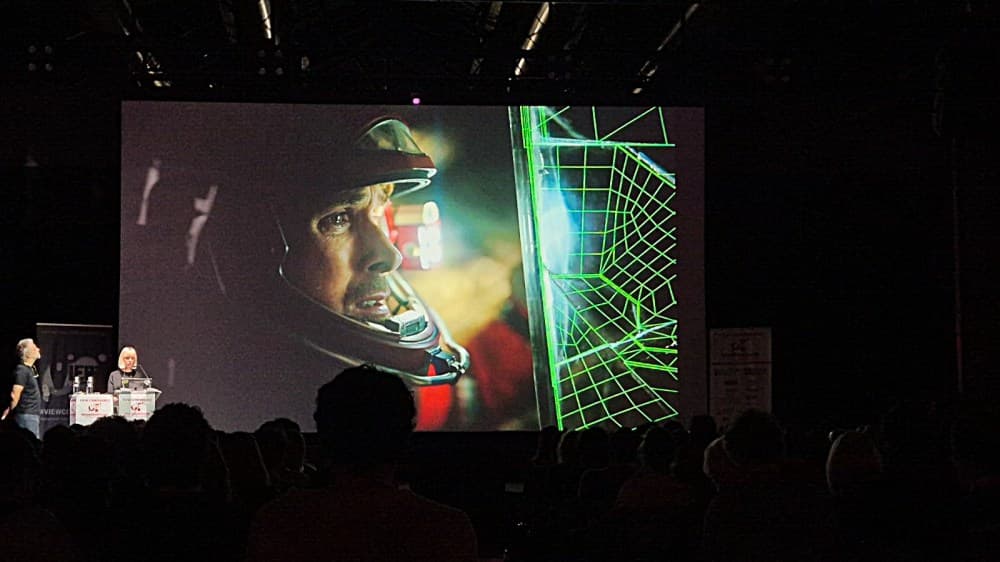
Paul Lambert Lambert explained at the View Conference in Turin, Italy, that zero-gravity was his primary concern during the production of the space epic Project Hail Mary, which stars Ryan Gosling. Lambert and Mag Sarnowska grounded the film's imagery in reality by combining cinematography with practical puppetry and astronomical data.
The team mapped stars between Earth and Tau Ceti, a system 11.9 light-years away, using data from the European Space Agency’s Gaia mission. Production staff also studied raw images and footage from the International Space Station to ensure accuracy.
Lambert noted, "We had visions of all these beautiful nebulae, but in the end, the skies were pretty much as we see them today, from Earth." Two months of exploration into virtual production preceded the actual filming.
The cinematographer used an infrared-modified camera, programmable IR lights, and water running in front of the lens to create specific effects. For the sequence near Adrian, the cinematographer collaborated with the Helios virtual-camera system from ILM.
Digital footage was printed onto Kodak film 5254 for Earth scenes and 5203 for space sequences. James Ortiz and a team of puppeteers performed the character Rocky.
Sarnowska stated, "Our full CG Rocky got really good at mimicking the puppeteers." Sarnowska added, "In the end, half of the Rocky shots were puppet and the other half CG."
The filmmakers employed 10mm and 16mm film formats for specific shots showing Rocky's sonar-based point of view.