
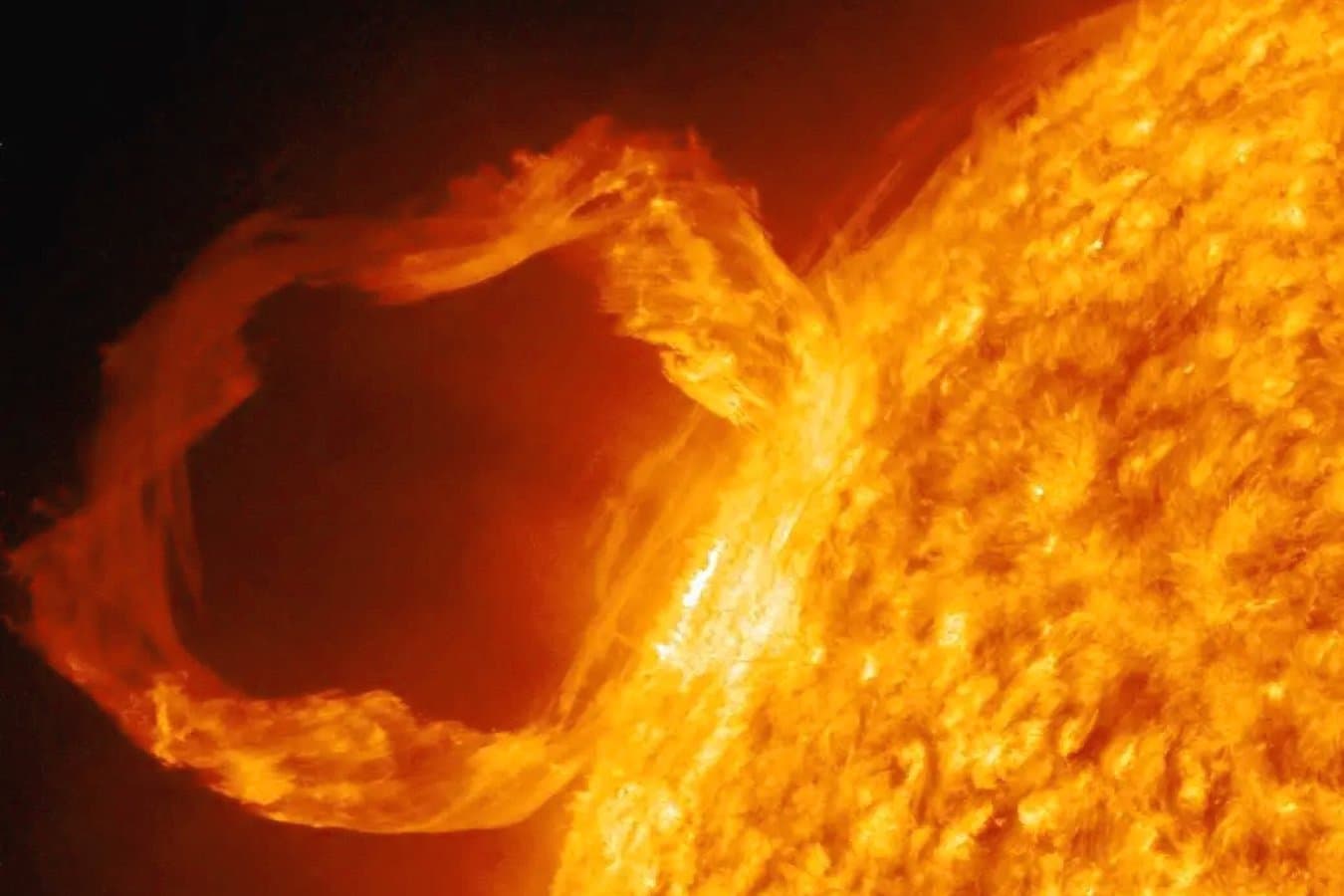
Researchers emulated a violent process that may occur on the sun by using powerful lasers and a tiny piece of plastic. The study could help explain why the sun's corona is thousands of times hotter than the sun's surface.
Wei Sun at the China Institute of Atomic Energy said, "It is as if the air grew hotter as you walked away from a campfire." The team observed how solar nanoflares could power the corona’s heat during the experiment.
Four powerful lasers were fired onto a tiny plastic target to produce a patch of plasma about 2 millimetres across. Scientists created plasmas in two different scenarios using a flat target and a wavy surface target.
In the wavy surface scenario, the plasma became unstable and magnetic fields rearranged to produce a nanoflare. This nanoflare in the wavy surface experiment reached temperatures of about 799,726°C.
The temperature in the wavy surface experiment was nearly double the temperature achieved in the flat target version. A computer simulation completed by the researchers corroborated the experiment results.
Rony Keppens at KU Leuven in Belgium said simulations support the team’s interpretation of the experiment and make for an interesting entry on the list of effects contributing to coronal heating. Keppens also said coronal rain blobs could lead to the kinds of instabilities that the researchers spotted in the lab.
Keppens noted the new experiment does not definitively resolve the coronal heating puzzle as other plasma behaviours like certain types of waves could also contribute. Wei and his colleagues want to upgrade their experiment to create more three-dimensional plasmas.
The team aims to use data about the sun collected through telescopes to make laboratory measurements more directly comparable to reality. Wei said, "It is important to check that the laboratory is reproducing what the sun does."