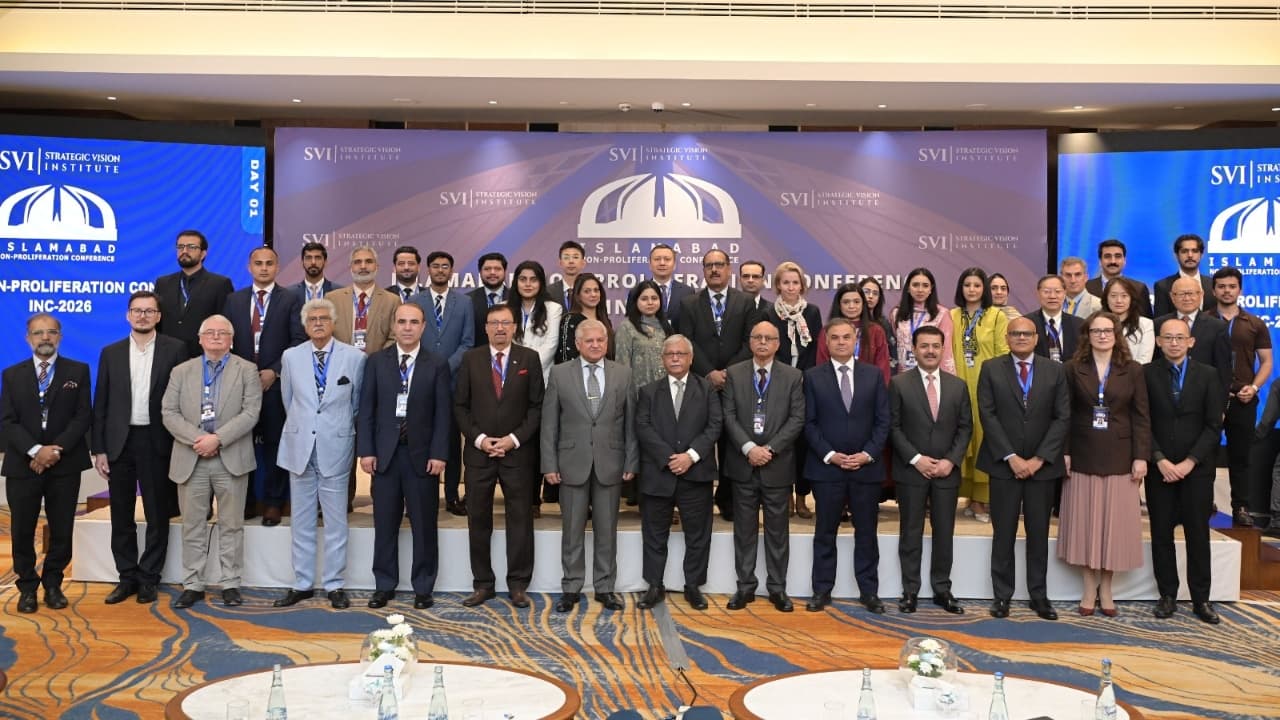
The Strategic Vision Institute (SVI) is hosting the second iteration of the Islamabad Non-Proliferation Conference 2026, a two-day international event. Dr Naeem Salik, Executive Director of SVI, welcomed guests to the conference.
Lt. Gen. Sarfraz Sattar, HI (M), (Retd.), Advisor to the National Command Authority (NCA), delivered the inaugural address. Sattar warned that disruptive technologies sit at the heart of the push towards bigger and better Nuclear Weapons, against the efforts of restraint or stability on the road to disarmament and sustained economic development.
The advisor claimed the nuclear age has shifted from threats by rogue or non-state actors to Great Power Competition and potential interstate conflict. He further stated that South Asia is a nuclear flashpoint due to India’s ultranationalist tendencies and Hindutva ideology in pursuit of Akhand Bharat.
Sattar noted the nuclear non-use taboo is weakening as the likelihood of interstate wars increases in lethality and expense. Khalid Ahmed Kidwai, NI, HI, HI (M), (Retd.), Advisor Development at the NCA, delivered the keynote address.
Kidwai stated that Pakistan’s Full Spectrum Deterrence (FSD) is fundamentally defensive to prevent aggression and preserve strategic stability in South Asia. He argued that Pakistan’s Full Spectrum Deterrence generated strategic effects in the May 2025 India-Pakistan conflict.
According to Kidwai, the SIPRI Yearbook 2026 finds India deployed approximately 12 nuclear warheads aboard a nuclear submarine for deterrence patrols. The advisor added that the absence of pre-notification of Indian SLBM tests could undermine South Asian strategic stability and increase risks of nuclear escalation.
Seven working sessions are scheduled during the conference to cover topics including deterrence dynamics, escalation risks, and the collapse of the arms control architecture. Zubair Mahmood Hayat, NI (M), (Retd.), Former Chairman of the Joint Chiefs of Staff Committee (CJCSC), will conclude the conference with an address.