
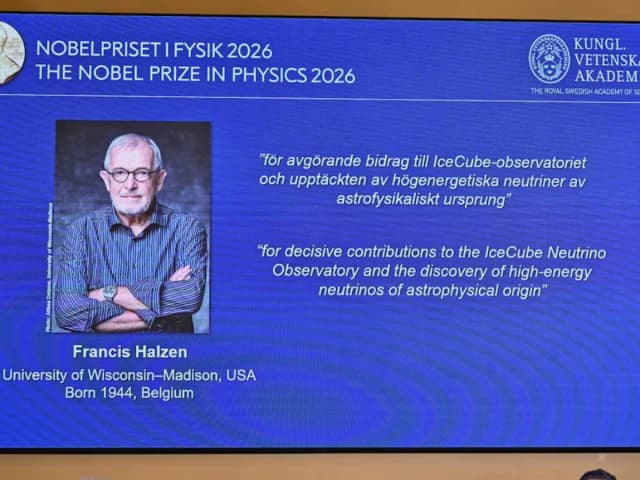
Francis Halzen won the 2026 Nobel Prize in Physics for his work on detecting high-energy neutrinos. The Nobel laureate, who is 82 years old, is a professor at the University of Wisconsin–Madison.
Halzen's research centres on establishing an observatory designed to detect high-energy neutrinos. The IceCube observatory, situated in Antarctica, provides the necessary data regarding these high-energy neutrinos.
This particle detector incorporates over 5,000 sensors and is positioned within Antarctic ice reaching a depth of 2,500 metres. The observatory is projected to record approximately one high-energy neutrino each day.
Neutrinos, which are electrically neutral, remain unaffected by any magnetic field. These high-energy neutrinos originate both within and far outside the Milky Way galaxy.
Halzen initially proposed the concept of capturing neutrino traces at the South Pole back in 1988. During the ceremony, King Carl XVI Gustaf of Sweden will present the Nobel medals in Stockholm on 10 December.
The Nobel physics laureate will receive an award valued at 12 million Swedish crowns.
Eva Olsson, of the Royal Swedish Academy of Sciences, stated, "The messengers bring information from the cosmos."
Eva Olsson, of the Royal Swedish Academy of Sciences


