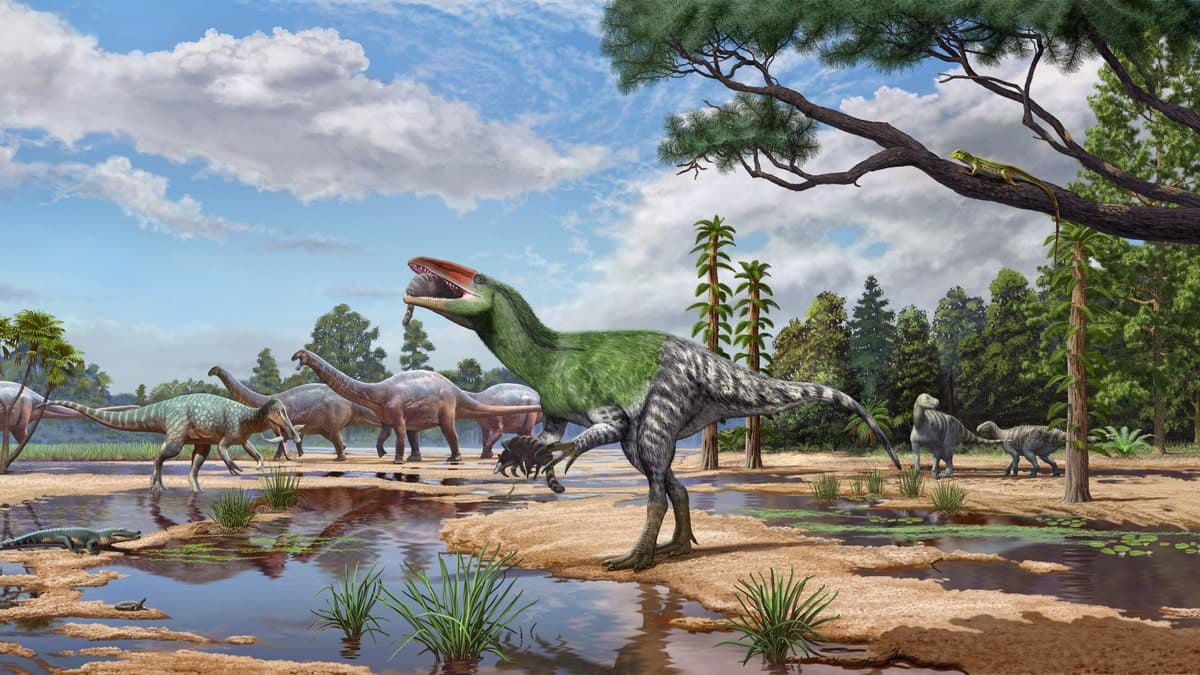
Researchers led by University College London (UCL) have identified a previously unknown species of meat-eating dinosaur named Invictibellatrix amberina. The creature lived in Britain approximately 120 million years ago and was roughly the size of a large tiger.
Found on the Isle of Wight, the fossil entered the Natural History Museum’s collection in 1924 after being gathered by amateur paleontologist Reginald Walter Tooley. Tooley collected more than 1,000 fossils during his career.
Dr. Cassius Morrison estimated the dinosaur stood slightly more than 1.5 metres tall and measured between 3 and 4 metres in length. The predator likely possessed claws measuring between 10cm and 20cm to hunt lizards, mammals, and small dinosaurs.
Invictibellatrix is the first known European member of the megaraptorans, which are two-legged carnivorous dinosaurs related to tyrannosaurs. While megaraptorans were widely distributed during the Early Cretaceous, they eventually disappeared from Laurasia.
In contrast, some megaraptorans in Gondwana evolved into predators with curved claws reaching around 35cm, such as the Maip macrothorax from Argentina which reached nine to 10 metres in length. Scientists used computed tomography scans to create a detailed 3D reconstruction of the skull fragment, revealing an oval opening for the spinal cord and a distinctive hourglass-shaped crest.
Charlie Scherer stated the discovery provides the first evidence that megaraptorans were present in Europe. The species name amberina refers to amber found in the rocks and a female given name, while the genus name was intended to offer encouragement to people facing bullying, discrimination, victimization and oppression.