
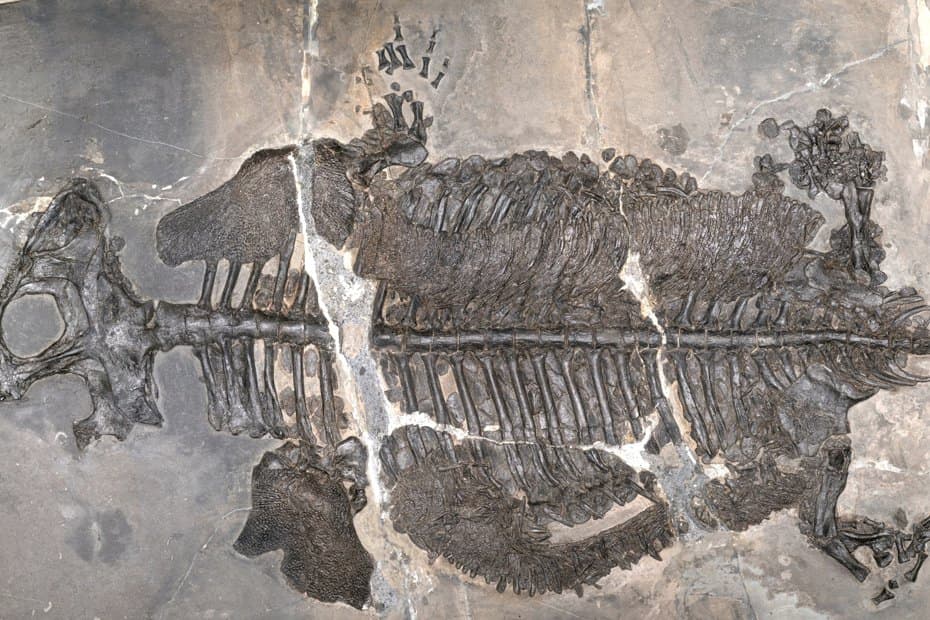
Farmers in Guanling county, China, discovered a 74-centimetre-long fossil of Gerrothorax maritimus, a fully marine amphibian from the Late Triassic Period. The specimen featured four legs and gills, and researchers identified a clear signature of sea water in the strontium isotope ratios of its bones.
Analysis indicates the creature lived at least 30 kilometres away from land 237 million years ago. The fossil was recovered alongside a Guizhouichthyosaurus, an ichthyosaur that reached lengths of 7 metres.
Ryosuke Motani at the University of California, Davis, described the creature as a flat animal that lived on the sea floor. Motani suggested the animal was likely an ambush feeder using suction feeding and noted there is no evidence that the creature underwent metamorphosis.
The species' closest relative, Gerrothorax pulcherrimus, inhabited freshwater environments. Motani stated, "There was a freshwater amphibian that happened to have the equipment needed to colonise the sea – the body armour."
The secret to survival in salt water probably lay in its strong body armour. John Long at Flinders University, Australia, noted that none of the 8000 or so living species of amphibians today is fully adapted for life in the sea.
Long observed, "If not for the marine invasion by many groups of reptiles at the same time, they might have even had a chance at diversifying in this niche, but that clearly didn't occur." Long added, "It shows us that amphibians closely related to modern forms were able to adapt to different environments, like seawater, in ways we never thought possible."